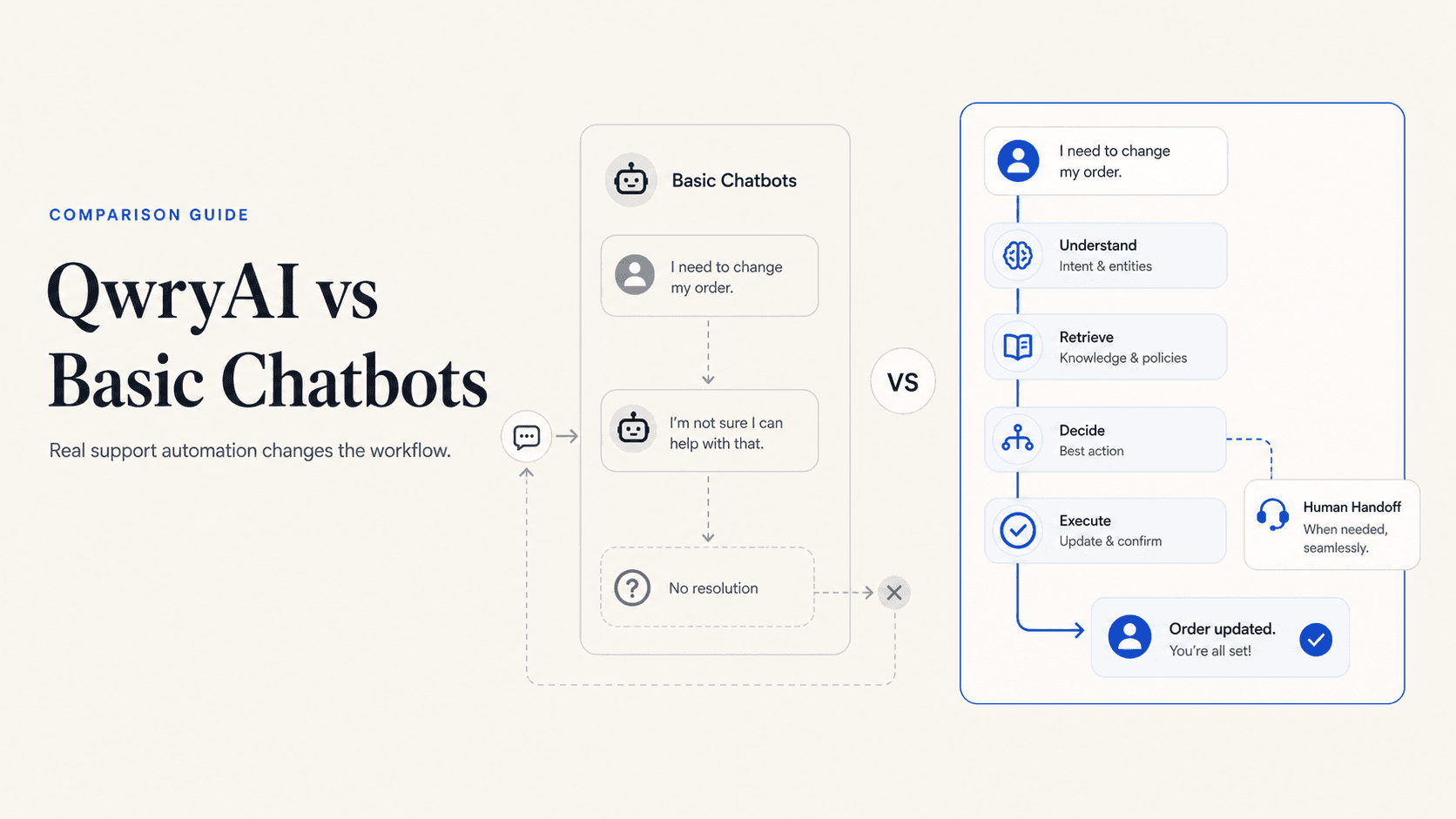
The easiest way to understand the difference between a basic chatbot and real support automation is to stop thinking about demos and start thinking about support queues.
In a demo, almost every chatbot looks fine. The question is clean. The answer exists in one help article. The flow ends in two turns. Everyone leaves impressed.
Real support does not look like that.
Real support is a customer who says, "My package says delivered but nothing is here, I used a discount code, and I need the replacement before Friday." It is a subscriber who wants to pause instead of cancel. It is a buyer who asks about a refund, then changes the question halfway through the conversation. It is a frustrated user who has already read your help center and is now testing whether your system can actually solve the problem.
That is where the gap opens up.
A basic chatbot is built to recognize a pattern and return a prepared answer. QwryAI is built for the moment when support becomes operational: when you need the system to understand messy phrasing, pull the right information from real sources, stay inside policy, and hand off cleanly when automation should stop.
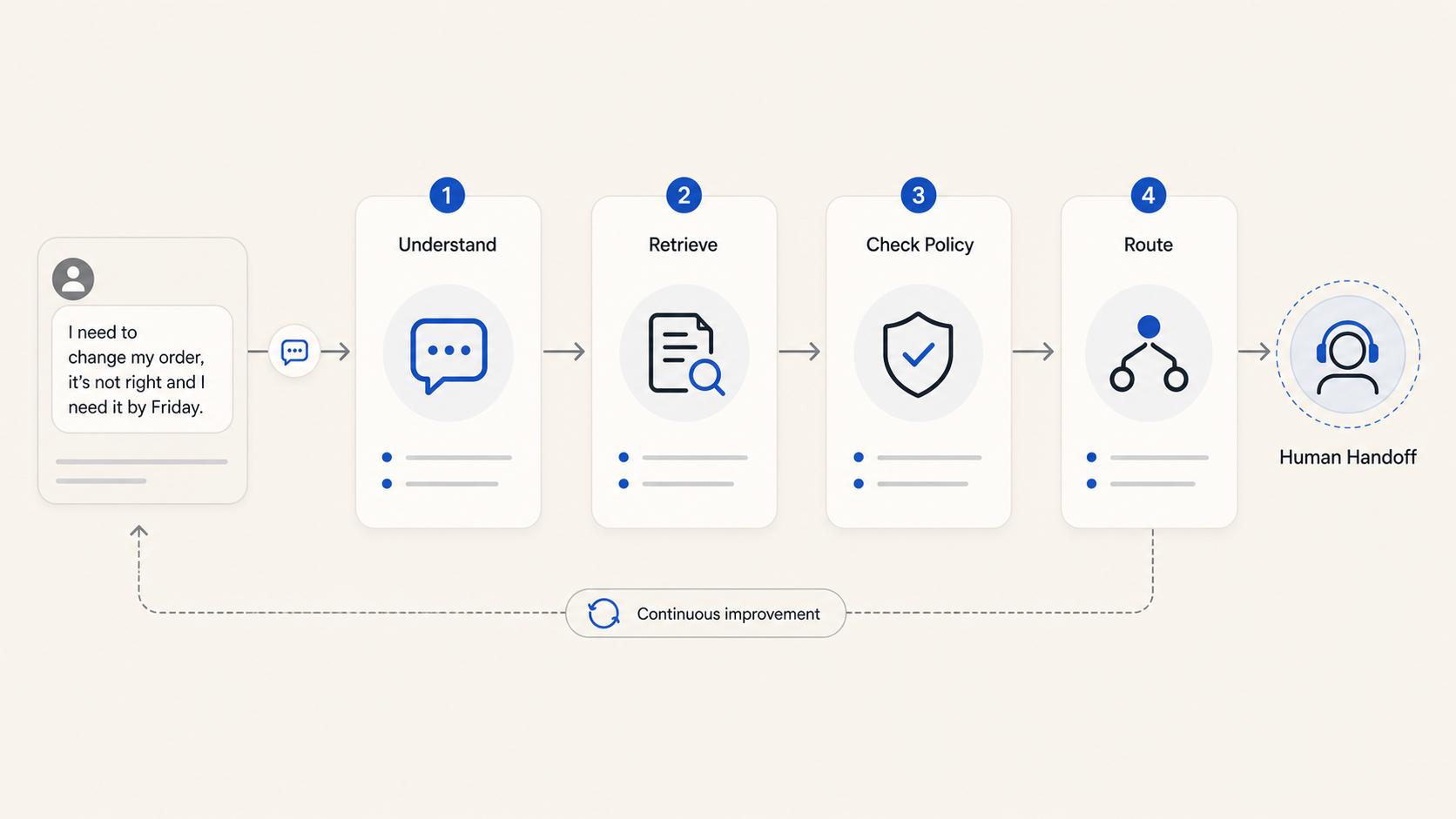
Most chatbot projects feel successful at the FAQ stage. The real test starts when automation touches outcomes, not just answers.
Basic chatbots work fine until the conversation stops being basic
Basic chatbots are not useless. They are often the right first step.
If your main goal is to answer a small set of repetitive questions like shipping times, password reset instructions, or pricing tiers, a lightweight chatbot can do that job well enough. It gives you 24/7 coverage, deflects some repetitive volume, and creates the impression of responsiveness.
The problem is not that these systems are bad. The problem is that teams often expect them to keep performing when the job changes.
Once customers need anything beyond a canned answer, the weak points show up fast:
- the bot matches keywords but misses intent
- it pulls one article when the answer needs three sources
- it gives the policy, but not the action the customer actually needs
- it loops instead of escalating
- it cannot explain why it answered the way it did
- it reports "engagement" while your agents still clean up the real work
That last point matters more than most teams realize. A chatbot can look busy and still create operational drag. If it delays handoff, gives vague answers, or forces customers to restate the issue to a human, it is not reducing workload. It is just moving the frustration.
What actually changes when you need real support automation
The change is not cosmetic. It is architectural.
When support automation becomes part of real operations, the system needs to do four things at the same time:
- Understand the customer request, even when the wording is messy, emotional, or incomplete.
- Ground the answer in trusted information, not just a generic language model response.
- Follow workflow and policy rules, especially when billing, subscriptions, returns, or account actions are involved.
- Know when to stop automating and route the case with proper context.
That is the shift from "chatbot" to "support automation."
QwryAI is built around that shift. Instead of treating support like a static FAQ problem, it treats support like an operating system made of knowledge, rules, confidence thresholds, analytics, and handoff logic.
QwryAI vs basic chatbots in the situations that matter
Here is the simplest comparison:
| Area | Basic chatbot | QwryAI |
|---|---|---|
| Core job | Answer predefined questions | Resolve repetitive support work safely |
| Understanding messy requests | Limited, often keyword-heavy | Better intent handling across natural phrasing |
| Knowledge usage | Usually one FAQ source or fixed scripts | Pulls from broader support knowledge and structured sources |
| Multi-step workflows | Fragile | Designed for guided support flows |
| Escalation | Often manual or rule-light | Confidence-aware handoff with context |
| Reporting | Clicks, sessions, deflection claims | Operational metrics tied to resolution quality |
| Risk control | Weak once conversations get sensitive | Better fit for policy-driven automation |
| Customer experience | Fine for simple requests | Stronger when the issue is real, specific, and urgent |
The table is useful, but it still hides the practical difference. So let us look at the kind of request that breaks simple bots.
A real support example: "I need to change my order before it ships"
On paper, this sounds easy.
In practice, the answer depends on several things:
- has the order already moved to fulfillment?
- what items are in the order?
- do warehouse rules allow edits at this stage?
- does changing the order affect discounts or shipping cost?
- should the system update the order, route the request, or explain why it cannot be changed?
A basic chatbot often responds with a generic article about order changes. That may technically be related, but it is not support automation. It is document retrieval with a chat box.
QwryAI is meant for the next layer. It can be configured around the actual support workflow: gather the right details, ground the answer in your policies, follow the action path you allow, and escalate when the request becomes exception-heavy or high risk.
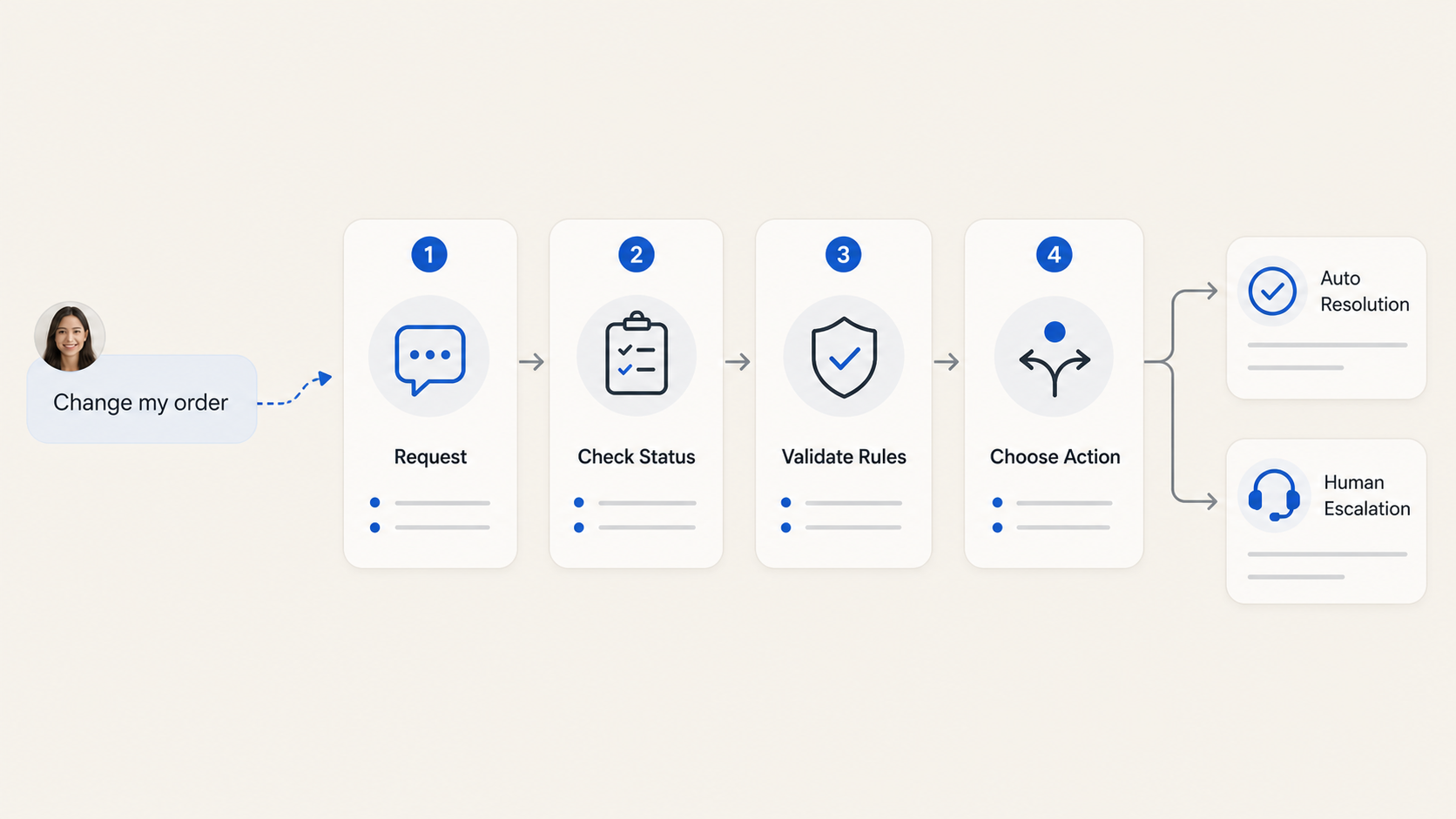
Good support automation is not just answer generation. It is classification, retrieval, policy checks, action routing, and measured escalation.
This is the difference customers feel immediately. Instead of getting an answer that sounds relevant, they get a response that actually moves the issue forward.
Why basic chatbot metrics can be misleading
One reason teams stay with underpowered chatbots for too long is that the reporting often sounds better than reality.
You will see metrics like:
- number of conversations handled
- article click-through rate
- percentage of chats not transferred
Those numbers can hide failure.
If a chatbot gives a weak answer and the customer leaves, that is not a win. If the customer opens an email ticket later because chat was useless, that is not deflection. If an agent has to reread the whole issue because the bot did not summarize context, the automation did not save time. It added another step.
Real support automation needs metrics that reflect the business outcome:
- resolution rate, not just chat completion rate
- escalation quality, not just escalation volume
- repeat-contact rate after automation
- time saved for agents on escalated cases
- customer satisfaction on automated interactions
- policy accuracy for sensitive workflows
This is a major part of the QwryAI difference. The value is not "the AI talked to customers." The value is "the system handled a meaningful share of repetitive work without lowering support quality."
What QwryAI changes for support teams
When teams move from a basic chatbot to a support automation platform, they usually notice five changes quickly.
1. Better answers under real customer phrasing
Customers rarely ask questions the way your help center titles them. They mix issues together, omit key details, and use emotional language. A support automation system has to interpret intent under those conditions.
That does not mean guessing more aggressively. It means narrowing the right problem faster and asking for the missing detail only when needed.
2. Better use of multiple sources of truth
Support answers often live across help articles, internal SOPs, billing rules, pricing details, and product-specific exceptions. A basic chatbot tends to flatten all of this into one shallow response style.
QwryAI is better suited for environments where support knowledge is wide, uneven, and operationally important.
3. Better safety when automation should not continue
Strong automation does not mean automating everything. In fact, one of the clearest signs of a mature system is that it knows when to stop.
Refund disputes, angry VIP customers, fraud signals, edge-case account issues, or low-confidence answers should not be trapped in an AI loop. They should move to a human with context attached.
4. Better workflow handling
Support is full of repeatable mini-processes: update shipping details, explain return windows, verify eligibility, route account access issues, collect missing information, and prepare the case for an agent.
Basic chatbots answer around those workflows. QwryAI is meant to operate inside them.
5. Better clarity on whether automation is actually working
This is the part leadership cares about. Are you reducing repetitive volume? Are agents getting cleaner escalations? Are customers resolving faster? Are you protecting quality while scaling?
If the system cannot answer those questions, it is hard to call it real support automation.
When a basic chatbot is still the right choice
Not every company needs a more advanced platform immediately.
A basic chatbot can still be the correct choice if:
- your volume is low
- your questions are mostly static FAQs
- the cost of a wrong answer is small
- you mainly want after-hours responsiveness
- your support operation is not yet documented well enough for deeper automation
That last point is important. If your policies are unclear and your support process changes every week, no tool will magically create operational discipline for you. Better automation works best when the business has at least some stable rules to automate against.
How to evaluate whether you have outgrown a simple chatbot
Ask these questions:
- Are customers asking blended questions that need more than one article or script?
- Do agents frequently re-answer conversations that the bot already touched?
- Are billing, returns, subscription changes, or account workflows part of the automation scope?
- Do you need trustworthy escalation rules instead of "contact support" as a fallback?
- Can you measure whether automation resolved the issue, not just whether the conversation ended?
If the answer is yes to several of those, you are no longer evaluating a chatbot problem. You are evaluating a support operations problem.
And that is where QwryAI fits better.
The practical difference in one sentence
Basic chatbots help you respond. QwryAI helps you operate.
That is the real distinction.
One is optimized for lightweight interaction. The other is optimized for repetitive support execution with guardrails, visibility, and controlled escalation.
If your support team only needs a polite front door, a simple chatbot can be enough. If your team needs automation that can reduce queue pressure without creating cleanup work, the standard changes. You need stronger retrieval, better workflow design, better escalation logic, and reporting that reflects what happened after the AI replied.
That is the bar real support automation has to clear.
Final takeaway
The wrong way to compare QwryAI and basic chatbots is to ask, "Can both answer customer questions?"
Of course they can.
The right question is: What happens when the conversation becomes operationally real?
What happens when a customer is vague, upset, in a hurry, or asking for something policy-sensitive? What happens when the answer depends on multiple sources? What happens when the AI should step aside and prepare a clean handoff instead of pretending to solve everything?
That is where the difference stops being marketing language and becomes a support outcome.
If your business is still at the FAQ stage, a basic chatbot may be enough for now. If you are trying to automate real support work without sacrificing customer trust, QwryAI is built for a different level of responsibility.
Written by

Co-Founder & CTO
Tamjeed is the CTO of QwryAI, leading the development of AI-powered customer support solutions. With a focus on technical innovation and scalable automation, he writes about building reliable AI agents and the future of support technology.
Frequently asked questions
Common questions about the ideas covered in this article.
Yes. They still make sense for narrow FAQ coverage, lead capture, and routing when the answers are fixed and the risk of being wrong is low.
A basic chatbot mainly answers or routes. Real support automation has to understand context, follow business rules, use live knowledge, and escalate safely when the task becomes sensitive.
Usually when support volume grows, answers need data from multiple systems, or mistakes start affecting refunds, customer satisfaction, or agent workload.